Loyalty - A Sermon for Sunday October 18 2026
We have been hearing stories from the Old Testament
about the God of the Covenant.
God promised Israel three things:
blessing, descendants and land.
God always keeps God’s promises.
In recent weeks, we have heard about God freeing Israel
from captivity to the Egyptians
and their escape through the sea,
and receiving the 10 Commandments.
As Israel wandered the wilderness,
trying to figure out what it means
to be a freed people,
how to be a blessing to others,
God gave them the law,
and the law is a gift
when you aren’t sure how to act.
God’s people have been blessed:
blessed to be a blessing.
God’s people have grown in numbers,
Abraham is the ancestor of a multitude.
Today, as we hear from Joshua,
the people have now been in the promised land
for some time.
God always keeps God’s promises.
If you ask people
what they know about the book of Joshua,
they’ll likely tell you about the battle of Jericho;
I mean,
it comes with its own classic Sunday School song!
Israel marched around the city of Jericho for 6 days,
and on the 7th day,
all the priests blew their horns,
and the people shouted
and the walls came a tumblin’ down.
From Joshua 6:17,
“The city and all that is in it shall be devoted to the LORD for destruction. Only Rahab the prostitute and all who are with her in her house shall live because she hid the messengers we sent….. all silver and gold is given to the LORD.”
From verse 21, “they devoted to destruction by the edge of the sword all in the city, both men and women, young and old, oxen, sheep and donkeys.”
Whoa.
Like the Flood,
it is not exactly a pretty Sunday School story.
The battle at Jericho,
and the book of Joshua on the whole
is about Holy War.
It is a brutal book,
a violent story;
a story that has been used to justify more violence
in God’s name.
We’ve been talking about
the problem of colonial violence in God’s name.
Don’t skip over the violence.
It is easy for us to look down on the violence.
It is easy to say, “How could they?”
I do not want to condone the violence,
but I also don’t want to be naive.
This was the way of the world.
Victory was only possible
with destruction of the defeated.
The notion of God’s victory happening
without violence
was unheard of in those times.
We ought to ask the questions:
Did they conquer the land and people
believing it was God’s will?
Did they commit colonial violence
and simply appropriate the name of God?
Was God violent?
The text is clear, it is God bringing victory.
Like the flood, was God sorry after the violence?
There are too many questions.
Take it seriously,
ask the questions,
and then let it be.
God is found in the muck and mud.
Know that these kind of stories
tell us what happened
and how these events were interpreted.
History is written by the victors.
Remember that amidst humanity’s greatest accomplishments
and even amidst our greatest moral failures,
God is at work.
Invite readers forward
You will note that today’s reading is a dramatic reading.
This scene is a religious, political event,
all the leaders and people called together,
with their leader - Joshua, at Shechem
at the place where
the judges will soon make their decisions.
This is a legal proceeding.
The people were called into reverence
and to decide which God they will serve,
after all, Israel had taken on other gods.
When Joshua spoke to the people
in the climax to this story
of the history of what God has done for Israel,
the people were invited to respond.
So, let us join the people Israel
and all the faithful
and respond to what God has done.
We welcome the scriptures with our acclamation,
Lord, let my heart be good soil.
Scripture Acclamation Lord, Let My Heart Be Good Soil (ELW 512)
Lord, let my heart be good soil,
open to the seed of your word.
Lord, let my heart be good soil,
where love can grow and peace is understood.
When my heart is hard, break the stone away.
When my heart is cold, warm it with the day.
When my heart is lost, lead me on your way.
Lord, let my heart, Lord, let my heart,
Lord, let my heart be good soil.
Pronunciation Guide
Shechem: SHEE-kehm Terah: TEE-ruh
Nahor: NAY-kawr Euphrates: yoo-FRAY-teez
Seir: SEE-er Balak: BAY-lak
Zippor: ZIH-pawr Moab: MO-ab
Balaam: BAY-lm Beor: BEE-awr
Jericho: JEHR-ih-ko Amorites: AM-uh-raits
Perizzites: PEHR-ih-zaits Canaanites: KAY-nuh-naits
Hittites: HIH-taits Girgashites: GER-guh-shaits
Hivites: HAI-vaits Jebusites: JEHB-oo-zaits
Narrator: A dramatic reading from the book of Joshua.
Then Joshua gathered all the tribes of Israel to Shechem, and summoned the elders, the heads, the judges, and the officers of Israel; and they presented themselves before God. And Joshua said to all the people,
Joshua: Thus says the Lord, the God of Israel: Long ago your ancestors—Terah and his sons Abraham and Nahor—lived beyond the Euphrates and served other gods. Then I took your father Abraham from beyond the River and led him through all the land of Canaan and made his offspring many. I gave him Isaac; and to Isaac I gave Jacob and Esau. I gave Esau the hill country of Seir to possess, but Jacob and his children went down to Egypt. Then I sent Moses and Aaron, and I plagued Egypt with what I did in its midst; and afterwards I brought you out. When I brought your ancestors out of Egypt, you came to the sea; and the Egyptians pursued your ancestors with chariots and horsemen to the Red Sea. When they cried out to the Lord, he put darkness between you and the Egyptians, and made the sea come upon them and cover them; and your eyes saw what I did to Egypt. Afterwards you lived in the wilderness a long time. Then I brought you to the land of the Amorites, who lived on the other side of the Jordan; they fought with you, and I handed them over to you, and you took possession of their land, and I destroyed them before you. Then King Balak son of Zippor of Moab, set out to fight against Israel. He sent and invited Balaam son of Beor to curse you, but I would not listen to Balaam; therefore he blessed you; so I rescued you out of his hand.
Joshua: (continued) When you went over the Jordan and came to Jericho, the citizens of Jericho fought against you, and also the Amorites, the Perizzites, the Canaanites, the Hittites, the Girgashites, the Hivites, and the Jebusites; and I handed them over to you. I sent the hornet ahead of you, which drove out before you the two kings of the Amorites; it was not by your sword or by your bow. I gave you a land on which you had not labored, and towns that you had not built, and you live in them; you eat the fruit of vineyards and oliveyards that you did not plant. Now therefore revere the Lord, and serve him in sincerity and in faithfulness; put away the gods that your ancestors served beyond the River and in Egypt, and serve the Lord. Now if you are unwilling to serve the Lord, choose this day whom you will serve, whether the gods your ancestors served in the region beyond the River or the gods of the Amorites in whose land you are living; but as for me and my household, we will serve the Lord.
Narrator: Then the people answered,
People: Far be it from us that we should forsake the Lord to serve other gods; for it is the Lord our God who brought us and our ancestors up from the land of Egypt, out of the house of slavery, and who did those great signs in our sight. He protected us along all the way that we went, and among all the peoples through whom we passed; and the Lord drove out before us all the peoples, the Amorites who lived in the land. Therefore we also will serve the Lord, for he is our God.
Narrator: But Joshua said to the people,
Joshua: You cannot serve the Lord, for he is a holy God. He is a jealous God; he will not forgive your transgressions or your sins. If you forsake the Lord and serve foreign gods, then he will turn and do you harm, and consume you, after having done you good.
Narrator: And the people said to Joshua,
People: No, we will serve the Lord!
Narrator: Then Joshua said to the people,
Joshua: You are witnesses against yourselves that you have chosen the Lord, to serve him.
Narrator: And they said,
People: We are witnesses.
Narrator: He said,
Joshua: Then put away the foreign gods that are among you, and incline your hearts to the Lord, the God of Israel.
Narrator: The people said to Joshua,
People: The Lord our God we will serve, and him we will obey.
Narrator: So Joshua made a covenant with the people that day, and made statutes and ordinances for them at Shechem. Joshua wrote these words in the book of the law of God; and he took a large stone, and set it up there under the oak in the sanctuary of
the Lord.
Word of God. Word of Life.
Thanks be to God!
Cal Ripken Jr., baseball’s ironman
was one of my favourite baseball players growing up.
His consecutive games played record
may never be broken.
This Hall of Fame-er will always be remembered
as a member of the Baltimore Orioles.
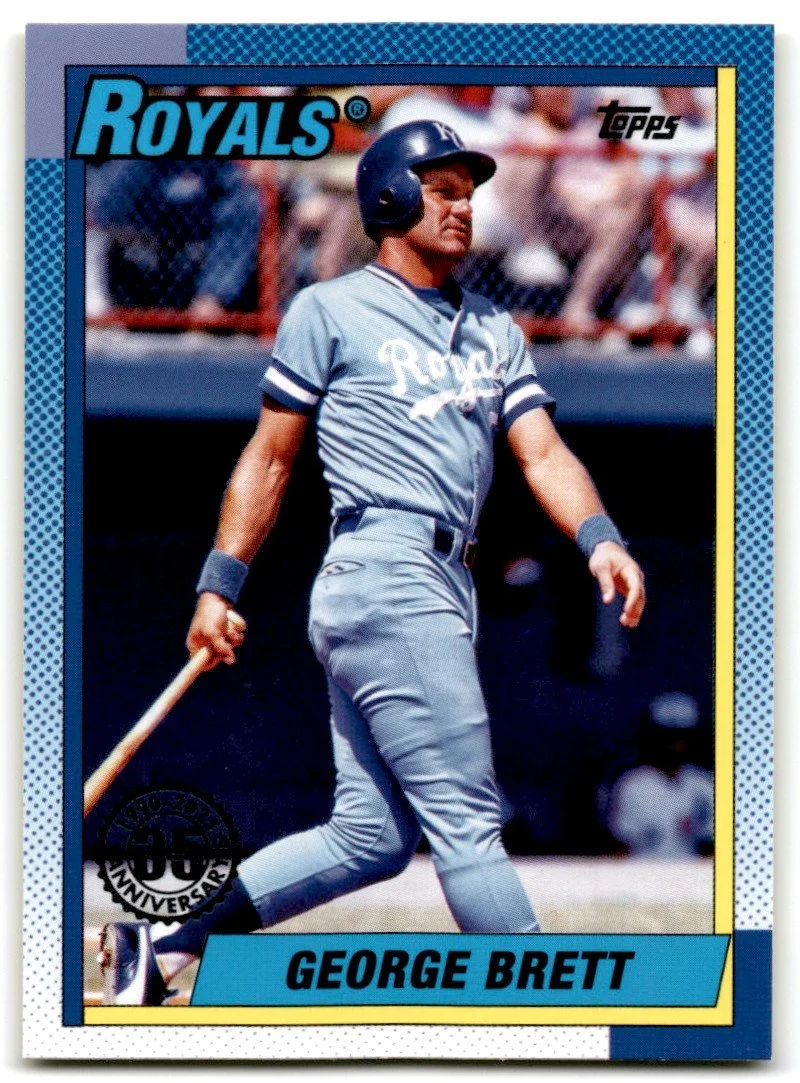
Another old favourite of mine is George Brett;
another hall of fame player,
who will always be a Kansas City Royal.
Players who were loyal to their team
from start to finish,
in good times and in bad,
through sickness and in health,
‘till retirement do them part.
You don’t see this as often in professional sports today,
let alone in marriages,
to play on the same team your whole life.
Playing for the same team your whole career,
means you might not win a championship.
You might not earn as much money.
Yet we know there is something special
to finishing your career
with the only team you've ever played for.
Then August 9th. 1988 happened.
You just say the date,
and many Edmontonians know exactly what it means.
That’s the day that Wayne Gretzky was traded
from the Edmonton Oilers to the Los Angeles Kings.
It changed sports forever.
Not even the best players in the league,
let alone the best on the team,
are safe from being traded.
In our own city,
even the great Jarome Iginla
left the Saddledome
to search for a championship elsewhere.
It mirrors the professional world today,
people do not stay in the same job
their whole career any longer.
Loyalty in sports, and in life…
It is not what it used to be.
There are mixed motives:
You want to be a team player,
but you want to maximize your paycheque,
and win a championship,
or perhaps to play with another certain player
or play for another team,
or go where you are valued,
not to mention family and personal concerns.
Professional athletes, like you and me today
have conflicting loyalties.
The book of Joshua is the story of Israel
entering and living in the Promised Land of Canaan.
Here’s the overarching point:
God has given Israel the land.
Keeping the land
depends upon Israel being faithful to YHWH
and living according to God’s laws.
This story is from the 13th century BCE (1250~),
but it wasn’t written until likely
around 7th century BCE.
That’s some 600 years of the story of Joshua
surviving in oral tradition
before its authors saw fit to write it down.
Why does this matter?
Well, this was written at a time in which
the people of Judah were facing invasion from Babylon.
Israel was defeated
because they turned away from God.
Israel was taken away into exile.
This passage,
telling a story from the 13th century
was really intended for a 7th century audience
who have been exiled
because they were not faithful to God
and who were not living
according to God’s laws.
Joshua’s iconic words:
“As for me and my house, we shall serve the Lord”
wasn’t so much a message for the Israelites
in Joshua’s time,
but a message for the Israel exiles
some 600 years later.
Joshua is a book of hope
for a people who have lost hope.
Here is the message to the exiles:
Be hopeful and be faithful:
you will return to your promised land
when you are faithful to God.
But a popular thought in those days:
The crops were good in this place we conquered,
so we better hold onto those gods… just in case.
And frankly,
we all can be like ancient Israel
and sing the Janet Jackson song,
LORD, YHWH, What have you done for me lately?
For better or worse,
the people might keep their god-options open.
Some were even hanging onto the Egyptian gods
from Israel’s time in slavery.
humans can sure be bizarre.
When you think of loyalty to sports teams today,
be it players or fans,
sometimes we remain loyal to our sports teams
because of geography,
but also because of past championships
and the hope of championships to come.
We like being identified as a fan of this team
and not that terrible team over there.
Sometimes that loyalty is rewarded;
like Calgary in 1989
or Chicago Cubs a decade ago,
after they won the world series
after 108 year drought.
Maybe even Vancouver Canucks fans
will be rewarded
for their loyalty some day,
though probably not.
Team loyalty is rewarded when your team wins,
and even with some schadenfreude - Shame-joy -
when your rival loses.
Sometimes victories seem so far away,
like the Flames these days,
and perhaps it feels that way even for Christ’s Church,
that it is easy to jump off the bandwagon
and cheer for another team.
Perhaps more seriously,
In this province,
we are about to take a vote
about particular provincial and national loyalties.
People are afraid. People are angry.
Sometimes victory seems too far away,
or impossible,
that we too might shift our loyalties.
Here’s the thing,
in life, in Church,
in hockey, or baseball, or whatever sport;
whether you are a professional
or just a recreational player
or even just a fan:
the reward isn’t winning the championship
nor always playing in a certain stadium,
nor in getting paid.
Playing the sport is its own reward.
Watching the game,
playing the game,
being part of the game
is its own reward.
When it comes to our God,
We might think of the destination,
that the resurrection of the dead,
life everlasting with all the saints is the reward.
Or we might think full pews and met budgets
are the reward.
Faithfulness is its own reward.
Serving Christ is its own reward.
Serving others is its own reward.
But people always want more.
Joshua said to the people of Israel;
God has done so much for you:
here’s the long list:
your descendants are many,
You are blessed by God,
you are in the promised land.
God got you here.
God continues to provide,
and you’re taking your loyalties elsewhere?
you abandon God now?
If it’s not going to be our God,
then choose today who you will serve,
but as for me and my house,
we will serve the Lord!
I invite you to take a moment and think:
What does your list look like?
What is on the list of the things
that God has done for you?
If your list is empty,
or just looks like a bunch of old stuff,
or your list says
“Ok, God, what have you done for me lately?”
Then let’s do coffee sometime and talk about it,
because your list is not empty or old,
like Israel, it is long,
even if you can’t see it now.
I have to remind myself,
amidst my own doubts,
my own fears
my own questions
my own mixed loyalties and motives,
that the list of what God has done for me is long.
By my list really only needs one thing: baptism.
What has God done for me? Baptism…
God has forgiven me.
God has chosen me.
God continues to do this,
day after day
for better or worse,
for richer for poorer,
whether I see it or feel it or not.
When it feels like God has abandoned you,
remember that God has been faithful
throughout the generations,
and God is faithful to you too.
God is with you,
even if you don’t feel it.
A profound truth:
God is most profoundly present in our suffering.
Put another way,
when we don’t perceive God,
that’s likely when God is most active.
Remember what God has already done for you.
You are saved.
You are freed from the powers of sin,
death, and the evil one.
Remember what God promises you,
God goes with you,
God will bring new life,
forgiveness,
blessing,
favour,
resurrection.
“Now if you are unwilling to serve the Lord,
choose this day whom you will serve…
Like Israel,
like professional athletes,
we too ought to be careful with our loyalties.
At best, our loyalties are mixed
and sometimes confusing.
Are we loyal to staying out of hell?
Are we loyal to our paycheques?
Or our clubs
or congregations
or employers
or families?
Some loyalties will not always pay off,
because they're not always loyal to you.
Our God is irrevocably committed to you.
Here is my aha moment from this past week.
The Old Testament has left people
wanting and expecting a Saviour,
a Messiah.
For Christians,
we believe, and perhaps take for granted,
that Jesus of Nazareth is that Messiah.
For our Jewish friends,
Jesus of Nazareth is not that Messiah.
Jesus of Nazareth shares a name with Joshua
- the book of Joshua.
Jesus and Joshua are the same name,
Yeshua.
It means “The Lord Saves.”
Some 2000 years ago,
The people,
the Jews,
the disciples;
they knew the book of Joshua,
and here comes Jesus, Yeshua of Nazareth,
and they’re expecting a book of Joshua
kind of Messiah:
Triumphant in battle,
a political and military power,
restoring Israel to glory
with conquering power.
Jesus reframes what a Messiah does,
who a Saviour is.
Jesus saves, the LORD saves,
but not like what was recorded in the book of Joshua.
God keeps God’s promises,
but not through military conquest,
not through oppression
and elimination of peoples and tribes,
rather God keeps God’s promises
through divine loyalty:
through a willingness to take on love,
compassion,
mercy,
forgiveness
and a willingness to die for the people
that God so dearly loves.
But it’s not just a willingness to die,
but to rise,
to bring new life,
to conquer death through life and love,
to usher in a better way,
to show us that the kingdom of Heaven,
- the kingdom of God -
is in our midst,
that God is with us in mercy,
in gratitude,
in compassion,
in love,
in peace.
Jesus takes our mixed motives,
our mixed loyalties
and says “I am still faithful to you,
I am still loyal to you!”
Remember that:
Even when we forsake our God,
or find our faithfulness fading,
Our God is always loyal to you,
for better or worse,
for richer for poorer.
In your baptism,
God has chosen you
and God is forever loyal to you,
and not even till death do you part
but for all of life
and death
and all eternity.
So I don’t know about you,
but amidst all those things crying out for my loyalty,
and amidst my own insecurities,
as for me any my household,
we shall serve the Lord.